AI Is Coming for the Coders — Not the Plumbers. Here's the Math.

I spent thirty years in the tech trenches watching an entire generation be told that “learning to code” was the only path to safety. But today, while AI is deleting entry-level software jobs by the thousands, it still can’t fix a burst pipe or wire a data center. I’ve secured my own sovereignty, and I’m telling you that a twenty-year-old apprentice welder is now on a path to out-earn a debt-ridden computer science grad by age twenty-five. Today I’m going to show you the math of the Asymmetric Trade Bet — the only career strategy that makes sense in a disrupted world.
Mike Rowe stood up at Carnegie Mellon in February of twenty twenty-six and said something that most of academia still won’t admit. He said, “We’ve been telling kids for fifteen years to learn to code. AI is coming for the coders. It’s not coming for the welders.” That clip went viral not because Mike Rowe is famous, but because he said out loud what the data has been screaming for years and everyone in the education establishment has been too invested — financially, ideologically, institutionally — to acknowledge.
This isn’t an opinion piece. This is a math problem. And math doesn’t care about your feelings or your diploma.
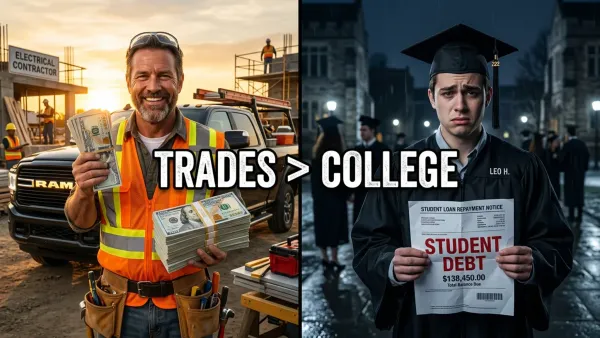
Entrepreneur.com reported in February 2026 that only thirty percent of college graduates are landing entry-level jobs in their field [1]. That’s a five-year low. Seven out of ten kids walking across that graduation stage with a degree in their hand and debt on their back are not getting the job they were promised. The Washington Post ran a piece at the end of January 2026 with this headline: “For the first time in fifty years, college grads are losing their edge” [2]. Andrew Yang’s research shows that college-degreed Americans now make up a record twenty-five percent of all unemployed [3]. One in four unemployed people in this country has a bachelor’s degree or higher. That number was unthinkable a decade ago. It’s reality now.
And here’s the part that makes this a crisis instead of just a trend. The average student loan debt for a 2026 graduate is thirty-eight thousand dollars. That debt starts accruing interest the moment they graduate. It follows them into a job market where seventy percent of them won’t land in their field. It’s not just a financial burden. It’s a structural constraint on every major life decision for the next ten to twenty years. It delays home ownership, family formation, and wealth building. It puts an entire generation on a slower trajectory at the exact moment the economy is accelerating.
Now layer AI on top of that. The disruption isn’t coming. It’s here. Entry-level coding jobs are being automated. Companies are using AI to write boilerplate code, handle testing, and manage documentation. The junior developer pipeline is collapsing because the work they used to do is being done by machines that don’t need salaries. A computer science degree that cost thirty-eight thousand dollars and took four years to earn is now competing with a tool that costs twenty dollars a month and improves every quarter. That’s not a career path. That’s a closing window.
I want to be precise about this because I’m not anti-education. I’m anti-bad math. If you’re going into medicine, law, or specific engineering fields, a four-year degree is still the only credentialing path and the return on investment still justifies the cost. I’m talking about the vast middle of the degree market — business, communications, general computer science — where the credential has been decoupling from the income for a decade and AI is now accelerating that decoupling into free fall.
In my book RIG THE GAME, I lay out a framework called Asymmetric Risk Math. The core principle is simple: a smart bet is one where the downside is capped and manageable, but the upside is open-ended or disproportionately large. A bad bet is the opposite. Most people never think about their major life decisions this way, but when you strip away the emotion and evaluate any major decision through the lens of risk and reward, the right choice usually becomes obvious.
Let’s run the college bet and the trade bet through the framework.
| Metric | The College Bet | The Trade Bet |
|---|---|---|
| Cost of Entry | $200,000+ (real cost including lost income) | $0 (paid while you train) |
| Employment Probability | 30% in field of study | ~100% in current market |
| Downside Risk | Uncapped (non-dischargeable debt) | Capped & Minimal (time spent, no debt) |
| Upside Potential | Moderate & Declining | Uncapped (ownership, scaling) |
| AI Vulnerability | High & Accelerating | Near Zero |
The math is not ambiguous. One bet has a favorable risk-reward structure. The other doesn’t. The gap between them is widening every quarter as AI advances and student debt compounds.
A licensed tradesman has multiple upside vectors that compound over time. First, employment income for a journeyman electrician, plumber, or HVAC technician is between sixty and ninety thousand dollars a year, with specialties climbing to a hundred and twenty thousand or higher. Second, a tradesman can start his own company with minimal capital because his primary asset is his license and his skill. Third, he can scale that business by hiring other tradesmen, moving from selling his time to selling the output of a team. A plumbing contractor with ten employees can gross over a million dollars a year.
Finally, a tradesman’s skills are anchored to physical reality. You cannot automate a pipe repair. You cannot download an electrician. The work requires a licensed human being to show up at a physical location and perform a physical task with his hands. That is the definition of disruption-proof.
I’m not telling you to forbid your son from going to college. I’m telling you to run the math with him. Sit down at the kitchen table. Look at the cost of the specific degree he’s considering. Look at the employment probability for that degree. Look at the AI vulnerability of the entry-level positions that degree leads to. And then look at the trade alternative. Let the numbers do the talking. A sovereign man doesn’t make decisions based on cultural momentum or prestige. He makes decisions based on the math.
Watch the full video: https://youtu.be/_NUs_g60oR4
Get IRON LOGIC on Amazon: https://www.amazon.com/dp/B0GKY3GQHT
Take my course — The AI-Resistant Spirit: https://www.udemy.com/course/ai-resistant-spirit/?referralCode=94ADF06C0D69A693E29B
References
[1] Entrepreneur.com, February 2026. "State of Entry-Level Hiring." [2] The Washington Post, January 2026. "For the first time in fifty years, college grads are losing their edge." [3] Andrew Yang, Q1 2026 Labor Report. "Unemployment Demographics Analysis."